EIFS Stucco Repair in Clearwater, FL: What to Know
EIFS isn't traditional stucco — it's a synthetic insulated wall system with its own failure modes. Here's what Clearwater property owners need to know before repairing it.
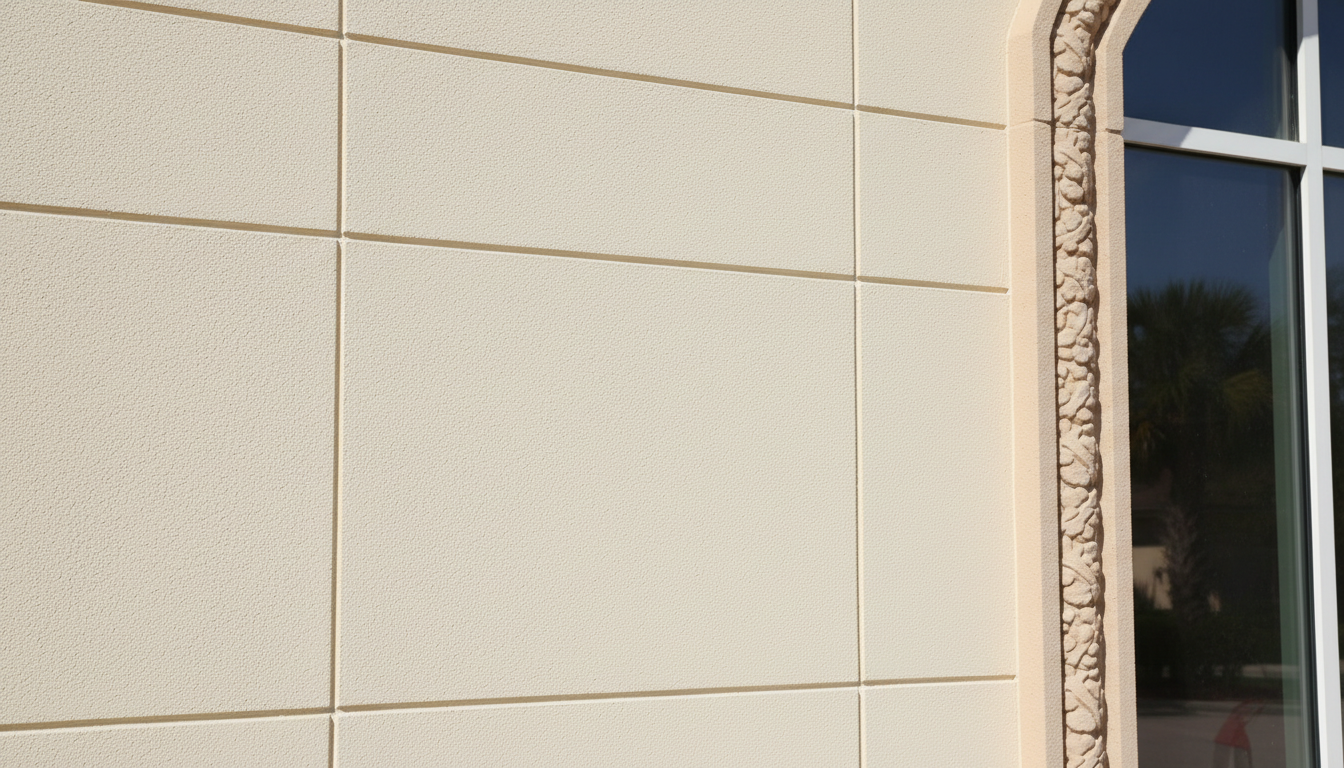
EIFS stucco repair starts with a distinction a lot of property owners never learn until something goes wrong: EIFS isn't stucco. It looks like stucco from the street, but Exterior Insulation and Finish System (EIFS) is a synthetic, multi-layer wall assembly — rigid foam insulation board, a reinforced base coat, and a thin textured finish coat — bolted to the building's exterior sheathing. Traditional hard-coat stucco is cement plaster applied in three coats over metal lath, with no foam layer at all. The two systems fail differently, and repairing one like the other is how a small problem turns into a big one.
Why EIFS Isn't Just "Synthetic Stucco"
The finish coat on EIFS is only a fraction of an inch thick, applied over a fiberglass-reinforced base coat that sits directly on foam insulation board — a completely different assembly than the cement-sand-lime plaster of hard-coat stucco. Because EIFS was built as an insulated cladding system first and a decorative finish second, industry standards from EIMA govern how it's installed and where it's allowed to manage moisture.
That distinction matters because of how the industry's own standards have changed. Early EIFS installations were commonly face-sealed barrier systems — designed on the assumption that sealants and coatings would keep 100 percent of water out, permanently. When a sealant joint failed years later, water that got behind the panel had no path back out. It sat against the sheathing and framing, sometimes for years, before anyone saw a visible sign on the surface. That failure pattern is why the industry standard shifted to EIFS with drainage, which builds in a gap and flashing details so incidental moisture can escape instead of accumulating. ASTM C1397 now governs installation practice for both Class PB EIFS and EIFS with drainage.
What EIFS Repair Actually Requires
Patching the surface of damaged EIFS without addressing what let water in behind it just delays the next failure. A proper repair sequence looks like this:
- Find the entry point. Almost never the finish coat itself — usually a failed sealant joint, a missing or improperly lapped flashing at a window or roofline, or a penetration (light fixture, vent, sign mount) that was never sealed to the system correctly.
- Cut back to sound material. Any foam board or base coat that's held moisture needs to come out, not just be skimmed over.
- Check the sheathing. If water reached the wall sheathing behind the foam, that's a structural question, not a cosmetic one, and it has to be resolved before the wall gets closed back up.
- Rebuild with compatible components. EIFS base coat, mesh, and finish need to match what's already on the building — mixing incompatible manufacturer systems is a common cause of repairs that fail again within a year or two.
- Correct the drainage or flashing detail that caused the original failure, so the repair doesn't just relocate the problem a few feet away.
Florida Construction Specialists works as always-prime contractor on every job, meaning the crew that diagnoses an EIFS failure is the same crew that repairs it — with an in-house engineer and architectural draftsman available when a repair calls for more than surface work. That matters most on EIFS, where the visible damage rarely tells the whole story of what's happening behind the wall.
Clearwater-Specific Considerations
Clearwater sits in Pinellas County, inside the Florida Building Code's wind-borne debris region, and EIFS shows up on a real share of the light-commercial and upscale residential buildings built here from the 1990s onward — a period when EIFS was popular nationally before drainage details became standard practice. Tampa Bay runs through two to three tropical systems a season, June through November, and the wind-driven rain from Hurricane Ian in 2022 and Hurricane Idalia in 2023 stressed exactly the sealant joints and flashing details that EIFS depends on to stay dry. A joint that held for a decade can fail during one storm season and go unnoticed until interior staining shows up months later.
Florida Construction Specialists has served Clearwater as part of its Pinellas and Hillsborough County coverage since 1982, holding certified building contractor license CBC1262722 through 44 years of exterior envelope work in this exact climate.
Have EIFS damage on a Clearwater property? Call (813) 420-7561 or contact us online. Learn more about our stucco repair services or our work across Pinellas County.
Frequently Asked Questions
How can I tell if my Clearwater building has EIFS or traditional stucco?
Knock on the wall. Traditional hard-coat stucco sounds solid and dense because it's cement plaster over lath. EIFS sounds hollow and slightly springy because there's a rigid foam insulation board underneath the finish coat. EIFS also tends to have a lighter, more uniform texture and fewer visible aggregate variations than hand-applied hard-coat stucco.
Why does EIFS fail differently than regular stucco?
Traditional stucco is somewhat permeable, so incidental moisture can dry out through the wall over time. Older EIFS was often installed as a face-sealed barrier system with no way to drain water that got behind it. Once moisture enters through a sealant failure or a bad flashing detail, it has nowhere to go, and it sits against the sheathing and framing instead of drying out.
Can EIFS on my Clearwater property be repaired, or does it need full replacement?
Most EIFS damage can be repaired if it's caught before the moisture has spread. That means cutting back to sound material, correcting whatever let water in — a failed sealant joint, a missing kickout flashing, a penetration that was never properly detailed — and rebuilding the assembly with compatible base coat, mesh, and finish. Full replacement is usually reserved for cases where moisture has traveled extensively behind the panels or the sheathing is compromised over a large area.
Does EIFS need different maintenance than regular stucco in a Tampa Bay climate?
Yes. Because EIFS depends on sealant joints at windows, doors, and penetrations to keep water out — rather than a breathable, semi-forgiving cement finish — those joints need more regular inspection here than in a drier climate. Tampa Bay's wind-driven rain during hurricane season stresses sealant joints every year, and a joint that's failed but hasn't visibly cracked yet is often where hidden EIFS moisture problems start.
Is a repair contractor who does traditional stucco automatically qualified to repair EIFS?
Not necessarily. EIFS is a manufactured system with its own base coat, mesh, and finish products that need to be compatible with what's already on the wall, and its moisture management depends on drainage details that don't exist in hard-coat stucco. A contractor who only works in traditional stucco can patch the surface, but without EIFS-specific experience, they can miss the drainage or flashing failure that caused the damage in the first place — and the same failure returns.
Ready to start your Clearwater project?
Florida Construction Specialists is Tampa Bay's premier general contractor for large-scale commercial, residential, and restoration projects. Call us for a no-pressure consultation.