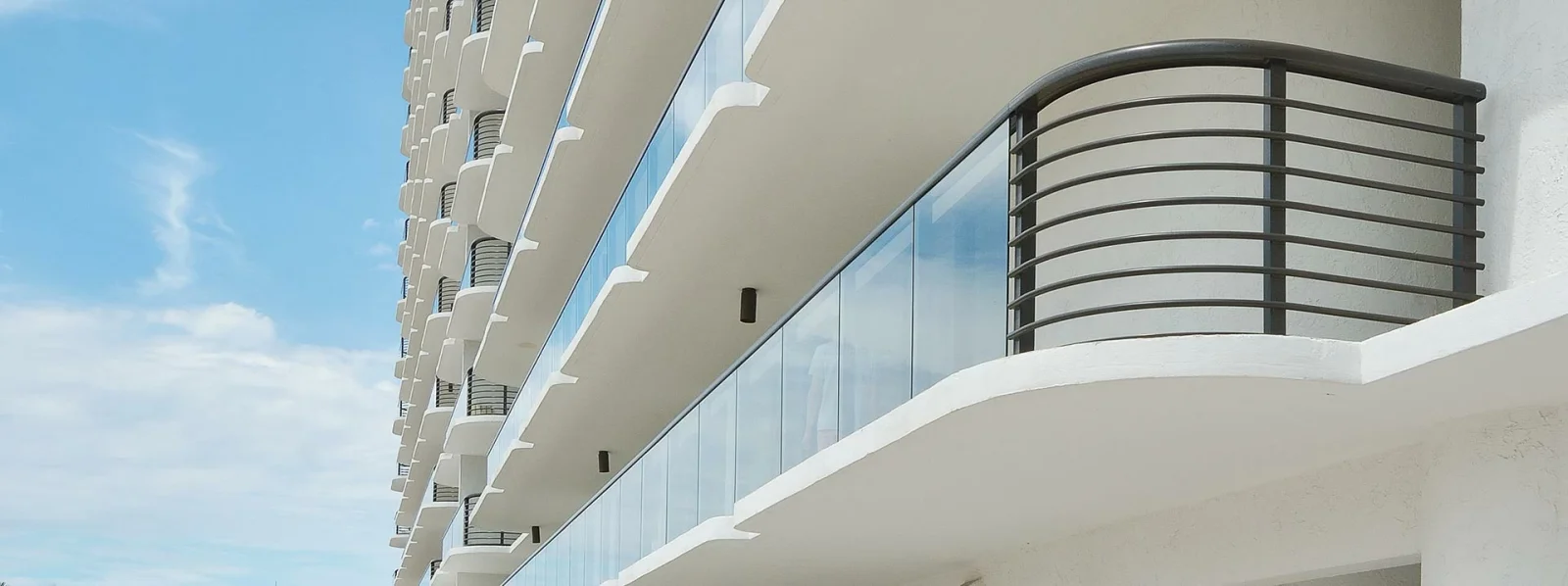
Balcony Railing Replacement in Tampa
A loose railing is rarely a railing problem. It is usually a post base that has been corroding inside the slab for years. Florida Construction Specialists replaces the guard and repairs what it is anchored to, as one scope.
The Railing Is a Structural Connection, Not a Fixture
Search for railing work in Tampa and most of what comes back is fabrication: ornamental ironwork, handrails, deck railings for houses. A condominium guard is a different job. It has to resist a defined lateral load with people leaning on it several stories up, it is anchored into a concrete slab that has been weathering for decades, and every anchor is a hole through a waterproofing system that is protecting the units below. The metal is the easy part.
That is why railing replacement on a multi-family building starts at the base rather than at the top rail. A post cast directly into the slab gives water a permanent route in; the embedded steel corrodes, expanding rust cracks the concrete around it, and eventually the post is being held by concrete that has already failed. Bolt a new guard into that same damaged pocket and you get a railing that is loose again within a few seasons.
Three trades touch a railing base: concrete, metal, and waterproofing. When they belong to three companies, each one blames the other when the post moves. Florida Construction Specialists is always the prime contractor and never a subcontractor, so the base repair, the guard, and the membrane detail are one scope with one name on it. We have worked in this market since 1982 under Certified Building Contractor license CBC1262722. Railing replacement sits within our condominium and multi-family structural restoration practice.
Replace the Guard, Repair What Holds It
Railing replacement for condominium and multi-family buildings across Tampa Bay
What a Failing Guard Looks Like
Residents notice movement. What we look for is the evidence around the base: rust bleeding onto the deck, hairline cracks radiating from a post, coating that has lifted in a ring around the penetration. Those are the signs that water has been inside the connection for a long time, and they usually appear on many balconies at once because every post on the building shares the same detail and the same age.
Guards themselves fail more slowly. Aluminum systems chalk and pit under salt-air exposure, welds crack where movement was never accommodated, and infill that was acceptable when the building went up may no longer meet current requirements. Replacement is the moment those get corrected rather than carried forward.
Conditions and What They Indicate
- A post that moves when pushedCorroded embedment or degraded concrete around it
- Rust bleeding from the base of a postWater sitting in the pocket and corroding steel inside
- Cracked or spalled concrete radiating from a postExpanding rust splitting the slab edge apart
- Pitting and chalking across an aluminum guardSalt-air exposure past the point of refinishing
- Stained, delaminated coating below the railing lineWater tracking down the post and through the deck
- Infill that a child could pass throughA guard that no longer meets current requirements
Replacing to Current Requirements
A replacement guard is specified against the Florida Building Code in force, not against the railing being removed. That covers guard height, the spacing of infill, and the lateral load the assembly and its anchorage have to resist. Where the original railing predates current requirements, replacement is the point at which the building catches up. Doing it deliberately, with the specification written down, is what gives an association a defensible record afterwards.
Anchorage is where specifications most often go wrong in practice. The capacity of a base plate is only as good as what it is bolted into, so anchor type, embedment, and edge distance are selected for the substrate actually present at the slab edge, which on an older building may be thinner or more deteriorated than the drawings suggest. That is a determination made from the condition survey, and it is why we survey every post base rather than a representative sample.
Florida Building Code, 2023 revision
Guards and wind-borne debris regions
The Florida Building Code governs guard height, infill spacing, and load resistance, and the 2023 revision raised structural standards for coastal construction. Balcony guards are exterior assemblies in a high-exposure environment, so replacement specifications address corrosion resistance and anchorage as well as geometry.
Every Anchor Is a Hole in the Waterproofing
A guard installed without regard for the membrane it penetrates undoes the deck repair beneath it.
Surface-mounted rather than embedded
Embedded posts penetrate the slab permanently and are almost impossible to reliably flash. Surface-mounted base plates sit on top of the finished waterproofing, so the penetration is limited to the anchors, and those can be flashed, sealed, and inspected later. On a balcony that has just been restored, that difference decides whether the new membrane keeps working.
Sequencing with the deck
Railing replacement, concrete repair, and waterproofing want to happen in a specific order: repair the slab edge, install the membrane and detail the perimeter, then set the guards into flashed penetrations. Doing them as separate projects months apart means the deck gets opened up twice and the second trade takes responsibility for the first one's work. Running them as one scope is both cheaper for the association and clearer when something needs to be put right.
Repairing the base before setting the post
Where the survey finds spalled or cracked concrete at a post location, that concrete is removed to sound material, the reinforcement treated, and the edge rebuilt before any anchor goes in. Anchoring into damaged concrete gives a connection that tests fine on the day and loosens under the first real wind load. That repair work is covered by our concrete balcony restoration scope and is normally run in the same mobilization.
Protecting the finished deck
Once guards are set, the deck coating and perimeter sealants are completed around them so water is shed away from every base rather than collecting at it. That work is covered under balcony waterproofing and traffic coatings, and it is what determines how long the new railings stay tight.

What a Railing Scope Includes
Guards are surveyed and priced per balcony, because condition varies with elevation and exposure even on a single building. The result is a scope that tells the board which balconies need concrete work at the base, which need the guard alone, and what the whole program looks like if it is phased across more than one budget year.
Railings are a life-safety item, so when a milestone inspection flags them the association needs more than an invoice to show the finding was closed. The per-balcony survey, the guard specification, and the anchorage detail are the record. See our SB 4-D compliance work for how those programs are run.
Typical Scope Elements
- Condition survey of every post base, not a sample
- Concrete repair at embedded and blown-out post pockets
- Guard system selection matched to exposure and maintenance
- Surface-mounted base plates with flashed, sealed penetrations
- Anchors specified for the substrate actually present
- Membrane and sealant integration at every base
- Code-compliant heights, infill, and load capacity
- Phased installation on occupied buildings
Why Associations Bring Railing Work to FCS
Florida Construction Specialists is always the prime contractor, never a subcontractor. Concrete, guards, and waterproofing come from one accountable party instead of three who each blame the other.
Prime Contractor
One contract covering the base repair, the guard, and the membrane detail.
In-House Engineering
An engineer and architectural draftsman on staff detail the anchorage before it is built.
Occupied Buildings
Phased balcony-by-balcony work with board and property manager coordination.
Since 1982
44 years working on Florida balconies under license CBC1262722.
Balcony Railing Replacement Service Areas
Florida Construction Specialists replaces balcony guards throughout Tampa and the wider Tampa Bay region, including St. Petersburg, Clearwater, Brandon, Lakeland, Sarasota, Bradenton, and Ruskin, where our office is located. Our railing work concentrates on condominium, multi-family, and commercial buildings across Hillsborough County and the Central Tampa Bay corridor.
Balcony Railing Replacement FAQs
Almost always at the base rather than in the rail itself. A post embedded directly into the concrete slab creates a permanent path for water into the deck. Once water sits in that pocket, the embedded steel corrodes, expanding rust cracks the surrounding concrete, and the post loosens. Our climate speeds up every stage of it. Summer relative humidity in the region averages around 75 percent, and the June-through-November storm season drives rain sideways at exactly the height where balcony guards sit.
Guards on balconies and elevated walkways have to meet the Florida Building Code for height, infill spacing, and the lateral load they can resist. Older railings frequently fall short on one or more of those points, either because requirements have changed since installation or because corrosion has reduced what the connection can actually carry. Replacement is the point at which a building brings its guards up to current requirements, so the specification is written against the code in force rather than matching what was there.
Surface-mounted base plates are generally the better detail on a waterproofed balcony. An embedded post penetrates the deck permanently and is difficult to flash reliably; a base plate sits on top of the finished waterproofing with its anchors flashed and sealed, which keeps the penetration inspectable and repairable. Embedded posts remain appropriate in some conditions, but on a restored balcony the surface-mounted detail is usually what protects the work underneath it.
Sometimes, but it is worth checking before assuming so. Where posts have been corroding, the concrete at each base has usually deteriorated with them, and setting new railings into damaged concrete simply relocates the problem. We survey the post bases first. If the slab edge is sound, replacement proceeds on its own; if not, the concrete repair is scoped alongside it under our concrete balcony restoration service so the new guard is anchored into something that will hold.
Each balcony is out of service while its guard is off, and an unguarded opening several floors up is a hazard in its own right, so temporary protection goes up the moment a guard comes down. We work in groups of units so residents lose their balcony for a defined window instead of the whole project. Access, notice, work hours, and daily cleanup are agreed with the property manager before mobilization, and progress is reported to the board on a fixed schedule.
We work throughout Tampa and the wider Tampa Bay region, including St. Petersburg, Clearwater, Brandon, Lakeland, Sarasota, Bradenton, and Ruskin, where our office is located. Railing replacement work concentrates on condominium, multi-family, and commercial buildings across Hillsborough County and the Central Tampa Bay corridor.
Have the Post Bases Surveyed Before You Buy Railings
Schedule a railing survey with Florida Construction Specialists. We check every base, tell you which balconies need concrete work first, and price the program so it can be phased.
Related Reading
Balcony Inspection and Reconstruction in Tampa: A Condo Board's Guide
Tampa balconies fail from the inside out — chloride intrusion, rusting rebar, failed membranes. Here's what an inspection finds and what reconstruction involves.
4 min readHow to Repair Large Stucco Holes in Tampa
Learn how to repair large stucco holes in Tampa the right way — lath replacement, three-coat application, cure times, and color matching for Florida's humid climate.
6 min read